What Is a Tandem Press Line? Robot Transfer Between Stamping Presses
A tandem press line is a stamping line made of several separate presses standing in a row. Each press performs one operation on the part, such as drawing, trimming, piercing or flanging, and robots or a transfer system carry the part from one die to the next so nobody has to load the presses by hand. You will find these lines in automotive body panels, appliance parts and other medium to large sheet metal components. This article explains how the line works, what it is made of, and what to think through before you automate a manually loaded press line.
What is a tandem press line, and how does it differ from progressive and transfer presses?
Multi-stage stamping is usually organised in one of three ways, each suited to different part sizes and volumes.
- Progressive die: one die with many stations in a single press, fed continuously from coil. Great for small, high-volume parts, but large or deep-drawn parts usually make the die too long and heavy.
- Transfer press: one large press with several stations and a built-in transfer system that moves all parts at once on every stroke. Fast, but it means buying a complete new machine.
- Tandem press line: separate presses, each with its own die, linked by robots. It is flexible, handles large parts, and in many plants it can be built around presses that are already on the floor.
Many plants in Thailand start with an operator standing at each press, lifting parts in and out of the die all shift. It is repetitive, tiring work close to a hazard zone. Moving to a robot-linked tandem line improves safety, keeps the rhythm of production consistent, and takes heavy lifting off people.
Main components of an automated press line
A complete line is more than the robots between presses. Several pieces of equipment have to work together.
- Destacker: picks blanks one at a time from the stack, usually with air knives or magnetic fanners to separate sheets, plus a double-blank sensor so two sheets never reach the die together.
- Washing or oiling station (if the process needs it) to prepare the surface for deep drawing.
- Centering station: aligns the blank before the first press, either with mechanical stops or a vision camera that measures position so the robot can compensate.
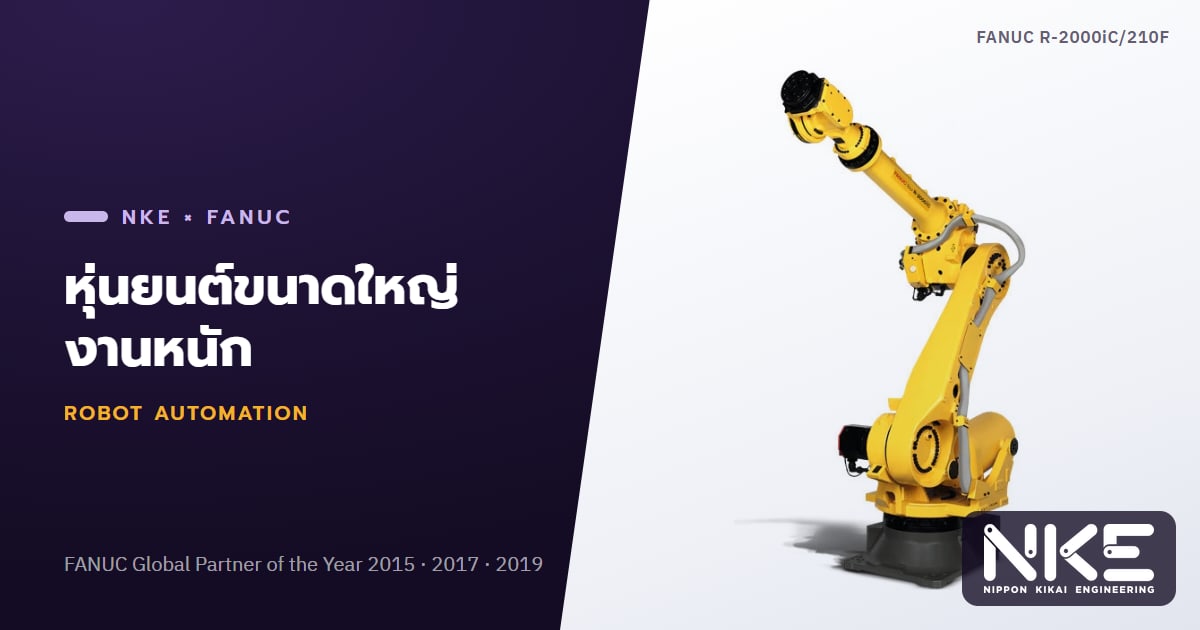
- Press-to-press robots: unload one die and load the next. They need enough reach and payload for the part plus the weight of the tooling.
- End of line: a robot or conveyor takes finished parts, allows inspection, and places them in racks or bins.
Robot selection depends on part weight, press spacing and die height. See how to choose an industrial robot by payload and reach for the basics.
The key to line speed: synchronising robots and presses
The output of a tandem press line depends less on how fast the robots move and more on how well robots and presses communicate.
Basic interlocking
The minimum is a signal handshake: the press may only stroke once the robot has left the die area, and the robot may only enter once the slide has reached a safe height. This is safe, but everything waits for everything else, so the line runs slower than the equipment could.
Overlapping motion
A well-designed line lets the robot start moving in before the slide reaches the top, and lets the press start down while the robot is still retracting. This is planned from the press crank angle and the robot path so that the two never collide at any moment. It removes a lot of waiting time, but it needs a reliable position signal from the press and careful testing.
Single-stroke or continuous mode
Older presses often stop at top dead center on every stroke, which is simple to link with a robot. Presses that can run continuously are faster but demand tighter synchronisation. Before planning, check whether the existing controls, brake and clutch are in a condition to handle more frequent cycling.
Tooling and die changeover
Press-line end effectors are usually vacuum cups mounted on an aluminium frame or crossbar built for each part, sometimes combined with magnets or clamping grippers. Points to consider:
- Tooling weight: a long, heavy frame eats into payload and forces the robot to reduce acceleration.
- Die clearance: the cups must reach the part without hitting die components. Check this while the die is being designed, not after it is built.
- Part detection: vacuum sensors should confirm a secure pick before the robot moves on.
- Tool changers: on lines that run many part numbers, automatic tooling change linked to recipe selection speeds up die changes and prevents running the wrong robot program.
For more detail, read our guide to selecting robot grippers and end effectors.
What to consider before investing, and common mistakes
Questions to answer first
- What are the part sizes, weights and number of variants, and how often do you change dies?
- Does the current press spacing suit the robot reach, or will presses need to move?
- Can the existing presses output a slide position signal and accept external commands? Do their controls or safety systems need upgrading?
- Is there room for guarding, die-change access doors and maintenance walkways?
Common mistakes
- Estimating line rate from robot speed alone, ignoring press waiting time, vacuum confirmation and destacker time.
- Not budgeting for die modifications: dies designed for manual loading may have no room for robot tooling, or parts may stick in the die without ejectors.
- Overlooking safety, for example die-change doors that are not interlocked with both the robots and the presses.
- No plan for data: if you do not know why the line stops, it is hard to improve. Start recording stop reasons and tracking OEE from day one.
NKE designs and builds tandem press lines alongside other factory automation systems. See an overview of our work on the factory automation page.
FAQ
Can older presses be used in a tandem press line?
Often yes, but the presses need a survey first: brake and clutch condition, controls, slide position signals and safety systems. Some presses need a control upgrade before they can be linked to robots.
Should I use robots or a dedicated transfer system?
Robots are more flexible: you change part numbers by changing tooling and programs, and the robots can be redeployed later. A dedicated transfer can run faster on a single high-volume part. The choice depends on how many variants you run and your volumes.
Does a robotic press line still need operators?
Yes. People are still needed to replenish blank stacks, change dies, inspect parts at the end of the line and look after the equipment. Their role shifts from lifting parts at the danger zone to running and maintaining the system.
If you are thinking about converting a manually loaded press line into a tandem press line, or would like our team to look at the presses you already have, contact NKE, call 02-746-7196 or message LINE @nke.th to talk through your application.