FAT and SAT Explained: How to Accept an Automation System
When a factory invests in a robot cell or an automated machine, the stage that causes the most disagreement is rarely the design. It is acceptance: deciding whether the system really does what was agreed. This article explains what FAT and SAT are, how the two tests differ, what each should cover, and how to set acceptance criteria that the buyer and the system builder both understand from day one.
What are FAT and SAT, and how do they differ?
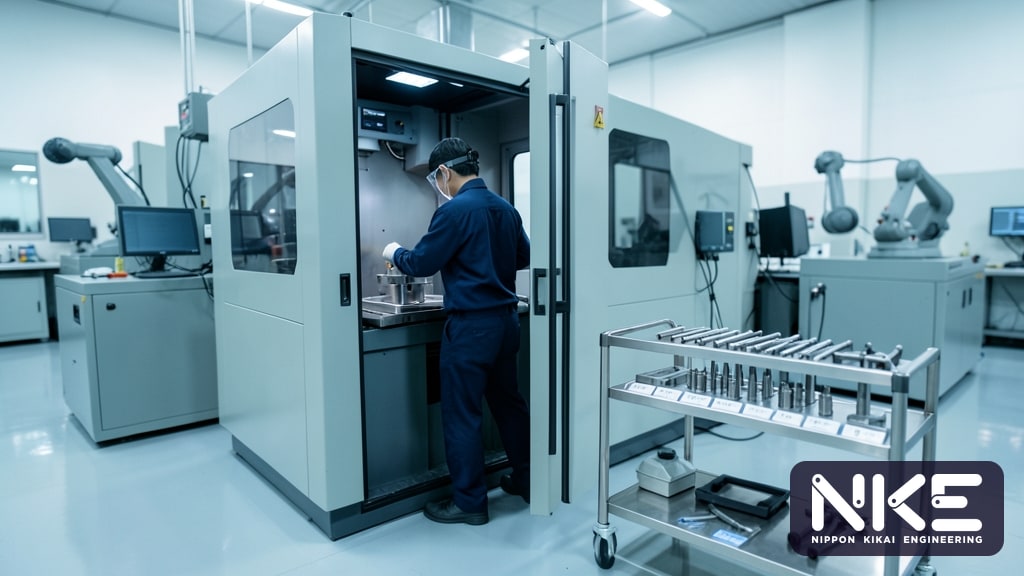
FAT (Factory Acceptance Test) is the test and sign-off carried out at the builder's facility, such as a system integrator or machine maker, before the system is dismantled and shipped. SAT (Site Acceptance Test) takes place after installation at the customer's plant, using the real power and air supply, real parts and real operators.
FAT: catch problems before the system leaves the workshop
Issues found during FAT are far easier and quicker to fix. The mechanical designers, electricians and programmers are all on hand, tools and spare components are close by, and the customer's production line is not affected at all. Modifying a frame, reworking a gripper or editing a program at this stage costs much less than doing the same work on site.
SAT: prove the system works in real conditions
Some things can only be verified on site: the plant's power quality and air pressure, signal exchange with existing machines or conveyors, variation in raw parts from real suppliers, dust and heat, and how operators on different shifts actually run the cell. That is why many projects add a run-off period, a sustained production trial after SAT, before final sign-off.
Start with measurable acceptance criteria
An acceptance test is only as good as the specification behind it. If the URS (User Requirement Specification) or the quotation is vague, each side will read it differently on test day. Agree on the following before design starts:
- Parts to be handled: models, sizes, weights, materials and the tolerance range of incoming raw parts
- Cycle time: the target and how it is measured, including start and end points and whether changeover is included
- Part quality: which dimensions are checked, with what gauges, and on how many samples
- Continuous running: test duration and which stoppages are acceptable
- Safety functions: which devices and behaviours will be tested
- Documents and training: what is handed over and who must be trained
A hypothetical example: “cycle time under 60 seconds” is not enough. State that it is measured from the robot picking a raw part to placing a finished part, averaged over a defined number of consecutive parts, on a named part model. These figures should match the assumptions used in your investment case, as discussed in Is a CNC machine tending robot worth it?
What should a FAT cover? A basic checklist
- Mechanical and electrical inspection: build quality, cable and hose routing, device labels and the control panel
- I/O check: every sensor, valve and handshake signal between robot and machine works correctly
- Safety functions: emergency stops, door interlocks, light curtains and robot motion limits
- Operating modes: manual, auto, return to home, and restarting after a mid-cycle stop
- Part changeover: how long it takes and whether operators can do it themselves
- Cycle time: measured with real parts using the agreed method
- Fault recovery: a missed grip, a dropped part, low air pressure or a power cut, and whether the system alarms clearly and recovers safely
- Endurance run: both dry runs and runs with parts, to confirm stability
A key tip: send the builder enough real parts well in advance, including some near the edge of tolerance, not just the best-looking samples.
SAT and the production run on site
After shipping and installation, the system has to prove itself again under real conditions. A typical SAT includes:
- Checking installation, anchoring, levelling and clearances to nearby equipment
- Verifying power, compressed air and grounding
- Re-checking taught positions and fine-tuning after transport
- Testing integration with existing machines, conveyors or data systems
- Repeating every safety function test on site
- Running production continuously for the agreed time and conditions
- Training operators and maintenance staff
- Handing over documents: mechanical and electrical drawings, program backups, spare parts lists and manuals
Record stoppages and their causes during SAT. This becomes the baseline for long-term tracking and a natural starting point for measuring OEE once production begins.
Common mistakes in automation acceptance
- No measurable criteria: phrases like “works well” or “faster” instead of numbers and methods
- Testing only with perfect parts: the system then struggles with real, more variable stock
- Skipping FAT to save time: problems surface on site, where they are harder to fix and disrupt production
- Site not ready: missing power, air or floor preparation delays SAT
- No punch list: open issues are not recorded, owned or scheduled
- End users left out: operators and maintenance see the system for the first time at handover
- Signing off without program backups: recovery becomes difficult when something goes wrong later
A good punch list separates items that must be fixed before handover from items that can be closed afterwards without affecting production or safety, each with an owner and a target date. Looking at results across quality, cost, delivery and safety, as in the QCDESM approach, keeps acceptance criteria from focusing on speed alone.
FAQ
If the system passes FAT, do we still need SAT?
Yes. FAT confirms the system works in a controlled setting, but transport, site utilities, real parts and integration with existing equipment can only be tested at your plant. SAT is the final confirmation before the system goes into production.
Who should attend FAT and SAT?
Ideally representatives from production, maintenance, quality and safety, plus the operators who will run the cell and the project manager. Each group spots different issues, and involving them from FAT onwards makes training and handover much smoother.
Can 3D simulation replace FAT?
No. 3D simulation is very useful during design for checking layout, robot reach, collisions and early cycle time estimates, but it cannot confirm how a gripper behaves with real parts, or how sensors, cabling and part variation affect the system. The two complement each other.
If you are planning a robot cell, machine tending project or automated machine and want clear specifications and acceptance criteria from the start, NKE's engineers are happy to help. Learn more about our factory automation work, or contact NKE through the form, by phone on 02-746-7196, or on LINE @nke.th.