What Is SMED? Cutting CNC Changeover Time with Fixtures and Tooling
Every minute a CNC machine stands still for a model change is a minute with no good parts coming out. As batch sizes shrink and part variety grows, many plants discover that setup time is quietly eating a large share of their capacity. This article explains what SMED is, how it works, and how to apply it to CNC machining through better jigs, fixtures and tooling, along with the mistakes that most often hold teams back.
What Is SMED and Why It Matters for CNC Machining
SMED stands for Single-Minute Exchange of Die, a method developed by Shigeo Shingo within Japanese production systems. It was originally aimed at press die changes, with the goal of bringing changeovers into single-digit minutes, meaning under ten. Today the same thinking is applied to CNC machines, injection moulding, assembly lines and robot cells.
Long setups hurt in several ways at once:
- They reduce Availability in OEE, because the machine is stopped.
- They push plants towards large batches to justify the setup, which inflates work-in-progress and finished-goods stock.
- They make it harder to accept rush or low-volume orders.
Define changeover time correctly. It normally runs from the last good part of the old model to the first good part of the new model at normal speed. Trial cuts, measurement and offset corrections are part of the changeover, not something separate.
The Core Idea: Internal vs External Setup
- Internal setup can only be done with the machine stopped: removing the old fixture, fitting new jaws, setting work offsets, running trial cuts.
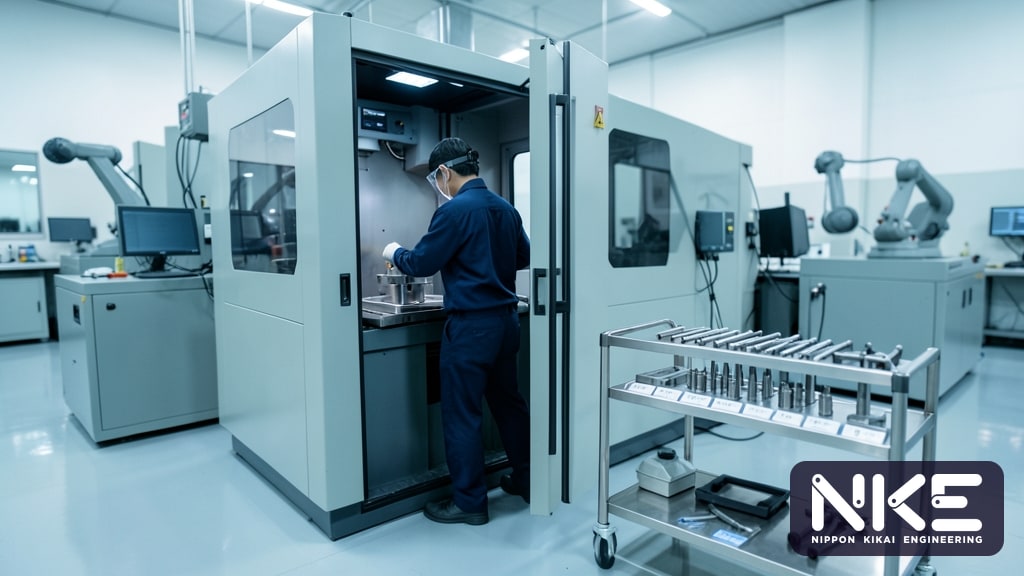
- External setup can be done while the machine is still running the previous job: preparing tools, bringing the next fixture to the machine, loading and checking the program, readying gauges and material.
In many shops the real problem is external work being done while the machine waits: hunting for a spanner, looking for the right bolts, waiting for a drawing. Fixing this often costs almost nothing.
Four Steps to Apply SMED on CNC Machines
1. Record the current changeover
Video a complete changeover and break it into individual steps with times. Start with the bottleneck machine or the parts that change most often. This becomes your baseline.
2. Classify each step as internal or external
For each step, ask whether the machine genuinely has to be stopped. Anything that does not should move before the stop, controlled by a preparation checklist.
3. Convert internal work into external work
This is where engineering comes in: measuring tool lengths offline on a presetter, mounting parts and fixtures on sub-plates in advance, and verifying programs by simulation before they reach the machine.
4. Streamline everything and standardise it
Reduce the number of bolts, replace dial-indicating with positive location, let two people work in parallel where it is safe, and capture the result as standard work so every shift does it the same way.
Designing Jigs, Fixtures and Tooling for Quick Changeover
Workholding design has a big influence on setup time. The basic locating rules are covered in our article on jig and fixture design and the 3-2-1 principle. Practices that help changeover directly include:
- Zero-point clamping or standard pallets, so every fixture shares the same base and datum and returns to the same position.
- Standard datums and heights, so different fixtures can use the same or similar work offsets.
- Fast clamping such as cam, toggle, hydraulic or pneumatic clamps instead of multi-turn bolts.
- Quick-change chuck jaws on lathes, with positive location so soft jaws do not need re-boring every time.
- Standard fastener sizes, so one spanner fits the whole fixture.
- Shared tool families, keeping common tools in fixed turret or magazine positions to reduce tool swaps.
- Clear marking and storage near the machine to avoid picking the wrong fixture.
Eliminating Adjustment, Usually the Longest Part
The loop of trial cut, measure, correct offset and cut again is often the longest and least predictable part of a changeover. Typical causes are fixtures that do not relocate repeatably, unknown tool lengths and offsets keyed in by hand, which invites errors.
Remedies include positive location with pins and datum faces, a disciplined way of transferring presetter data to the control, and a clear first-article procedure. Where parts are measured on a CMM and the results drive offset corrections, an Auto Offset system for FANUC CNC such as NKE AOC, which takes CMM results and writes tool and wear offsets to FANUC CNC machines automatically, can remove much of the manual keying from this stage.
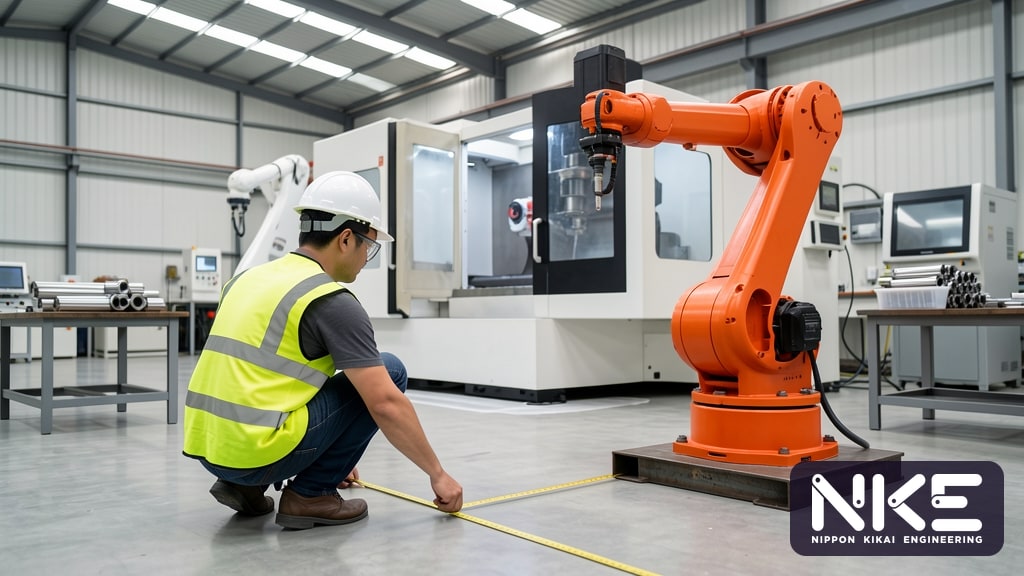
If a robot tends the machine, changeover also covers gripper fingers, part trays and the robot program. Design for recipe selection from the operator panel and finger changes that need no re-teaching. See our CNC and robot machine tending solutions for more.
Common SMED Mistakes
- Buying hardware before analysing, when most time is lost searching and waiting.
- No baseline, so improvements cannot be proven.
- No standard work, so the process slowly drifts back.
- Ignoring adjustment time and timing only the fixture swap.
- Relying on one setter whose knowledge is not written down.
FAQ
Does every machine need a changeover under ten minutes?
No. Ten minutes is a guiding target. Start with bottleneck machines or the most frequently changed parts, and set goals that match your actual production plan.
Does SMED require expensive equipment?
Not at first. Moving external work out of the stop and preparing tools in advance costs very little. Decide on quick-change fixtures or zero-point systems once the data shows where the time really goes.
How does SMED relate to automation?
Robots and automatic offset systems deliver more value when changeovers are short and standardised, because the machine spends more time producing. If changeovers are chaotic, automated equipment simply waits longer too.
If you want to review your changeovers, design jigs and fixtures, or plan a multi-model CNC and robot cell, NKE's engineers are happy to help. Call 02-746-7196, add LINE @nke.th or use our contact form.