Automation Feasibility Study: What to Check Before You Invest
Many automation projects start with the question “How much does a robot cost?” A better first question is “Can this job really be automated, and what is the right way to do it?” That is the purpose of an automation feasibility study: a structured check that lets engineering teams and management make decisions based on facts rather than assumptions. This article explains what a feasibility study should cover, what data you need, how the process works and the mistakes we often see on factory floors.
What Is an Automation Feasibility Study and Why Do It First?
A feasibility study checks whether a specific goal, such as having a robot load a CNC machine, stack cartons on pallets or pick parts from a conveyor, is achievable technically, physically, safely and economically. The outcome is not just a yes or no. It is a clear system concept that is detailed enough to estimate a budget and define the scope of work.
Why do it before committing money?
- It reduces the risk of buying equipment that does not perform as expected, for example a cycle time that cannot keep up or a gripper that cannot handle some part variants.
- It gets production, engineering, maintenance and purchasing looking at the same picture from day one.
- It gives you a common baseline to compare proposals from different suppliers fairly.
- It helps you decide which line to start with, or whether the process should be improved before it is automated.
Data to Prepare Before the Study
A feasibility study is only as good as the information that goes into it. The more complete the data, the closer the results will be to reality.
Part data
- Drawings or 3D models of every part variant that will run in the system
- Weight, material and surface condition (oily, burred, hot or fragile)
- How parts arrive and leave: in trays, loose in bins or on a conveyor
- Real sample parts for gripping trials
Process and production data
- Cycle time for each machine step and the takt time required by your customer
- Volumes, number of variants and how often you change over
- Everything operators actually do today, including hidden tasks such as blowing off chips, visual checks or periodic gauging
- Machine performance data such as OEE and the main reasons for stoppages
Site data
- Floor layout, column positions, walkways, forklift routes and ceiling height
- Available utilities such as power, compressed air and floor condition
- Machine models and controllers: can the doors be automated, and are signals available for interfacing?
A Step-by-Step Feasibility Process
- Set measurable goals. Be clear about the problem you are solving: labour shortage, more capacity, fewer defects or less hazardous work. Looking through the QCDESM framework helps make sure no dimension is forgotten.
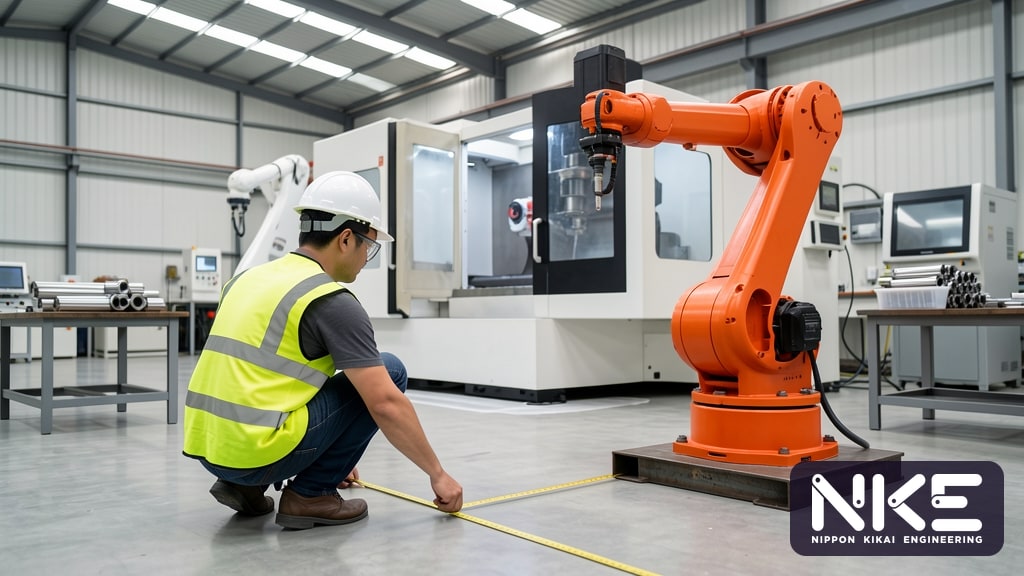
- Survey the shop floor. Watch the real operation, time it, take photos and talk to operators. Many issues never appear in documents.
- Run technical tests where there is doubt. Try gripping parts with a prototype gripper, test camera recognition or check how parts seat in the fixture. Our end effector guide covers gripper selection in more detail.
- Develop a concept layout and 3D simulation. Place the robot, machines, part buffers and guarding, then simulate the motion to check reach, collisions and an estimated cycle time.
- Assess risk and safety. Identify every reason a person must enter the cell, such as loading parts, changing tools or clearing faults, and plan protective measures at concept stage.
- Evaluate the business case. Compare the total cost with measurable benefits in labour, capacity, quality and safety. See Is robot CNC machine tending worth it? for a way to frame this.
- Report and recommend. Document options, limitations, assumptions and anything that still needs confirming so management can make a decision.
Technical Risks That Are Easy to Overlook
- Part variation. Castings and forgings are rarely uniform, which can make gripping or fixture loading unreliable.
- Chips and coolant. Chips left on a fixture or gripper stop parts from seating properly. Plan for cleaning from the start.
- Changeovers. With several variants, decide whether you will swap grippers, swap fixtures or design one set that handles all of them.
- Infeed and outfeed. How long can the cell run without someone refilling it? This largely determines how much operator time you actually free up.
- Interfacing with existing machines. Older machines may need automatic doors, powered workholding or extra control signals.
- Quality checks. If operators currently measure parts during production, decide how measurement and offset correction will be handled once the cell is automated.
Common Planning Mistakes
- Choosing hardware before defining the problem, for example buying a robot first and then looking for a job for it.
- Using catalogue cycle times instead of real timing or simulation, which leads to wrong capacity estimates.
- Testing only one part variant when production runs several.
- Leaving production and maintenance out of the discussion, so the system ends up hard to run or hard to maintain.
- Ignoring life after installation: training, spare parts and who responds when the system stops.
- Trying to automate everything at once. Starting with the clearest, most stable part of the process and expanding later is often the lower-risk path.
What You Should Get, and How to Decide
At the end of the study you should have a concept layout, simulated or tested cycle times, a list of major equipment, documented limitations and assumptions, a safety approach and a preliminary budget range. This package also becomes the foundation for your requirement specification and, later, your acceptance criteria.
The decision can take several forms:
- Go ahead with the concept when the data confirms it is feasible and worthwhile.
- Improve the process first, for example changing how parts are presented or redesigning a fixture, then automate.
- Phase the project, starting where the benefit is clearest.
- Not now, if current conditions are not right. That is still a valuable result, because it avoids an investment that would not deliver.
For an overview of what automation can do across a plant, visit our factory automation page.
FAQ
How long does a feasibility study take?
It depends on the complexity of the task, the number of part variants and whether physical testing is needed. A well-defined project with complete data moves faster than one that needs several rounds of gripping or vision trials. Agree on the scope and expected deliverables with your integrator at the outset.
Do we need 3D models of our parts?
Not strictly, but they help a lot, especially for gripper design and 3D simulation. If you do not have them, drawings plus real sample parts are usually enough for the integrator to build simplified models for the study.
How reliable is 3D simulation?
Simulation is very good at checking reach and collisions and at estimating cycle time, but it relies on assumptions such as machine door times, clamping times and how real parts behave. Combine it with timing on the shop floor and physical tests wherever the risk is highest.
If you are considering a robot project, a CNC machine tending cell or another automation system and want to start with a structured feasibility study, NKE's engineers are happy to talk through your requirements and site conditions. Call 02-746-7196, add LINE @nke.th or use our contact form.