Is robot CNC machine tending worth it? How to work out the payback
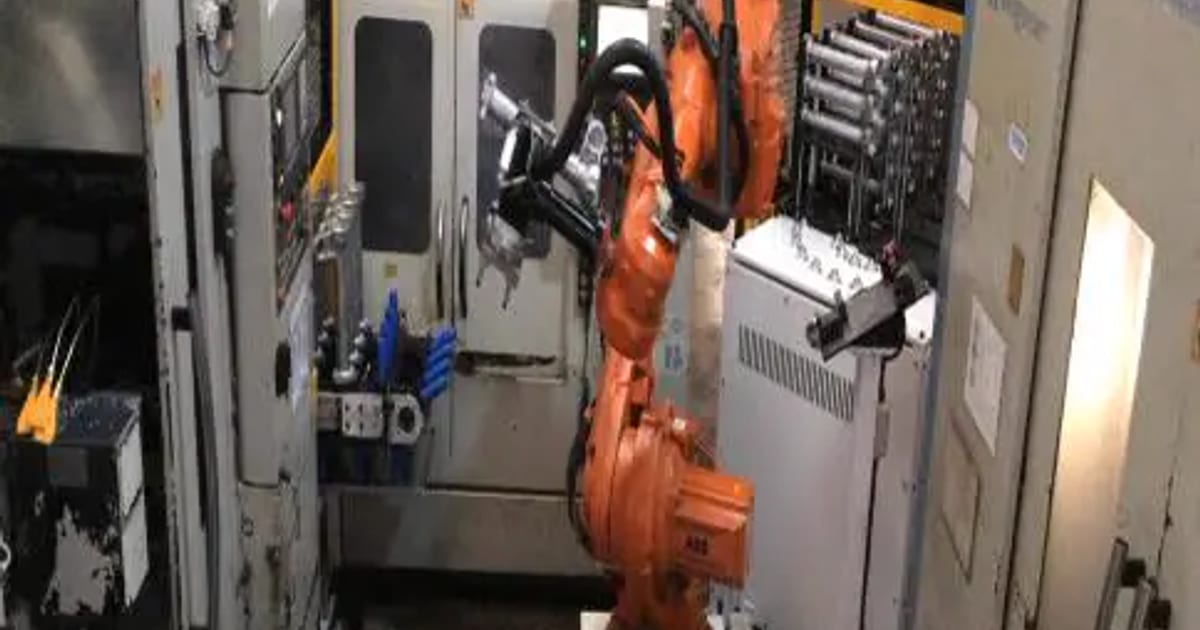
Many plants own expensive CNC machines that run far less than they could, because they wait for an operator to load parts, stop for breaks and shift changes, or sit idle when someone is absent. Robot CNC machine tending is increasingly the answer in Thai factories – but is it worth it for yours?
What is machine tending?
An industrial robot or cobot does the operator’s job at the machine: picks raw parts from a tray, drawer or conveyor, loads the machine, starts the cycle, unloads finished parts and may also blow off chips, flip parts or feed a gauge. One robot can tend one or several machines, depending on cycle times.
Signs it will pay off
- Repeat, high-volume work with long runs.
- Two or three shifts, or you want machines running through breaks and nights.
- Hard-to-fill operator jobs and high turnover.
- Heavy or hazardous parts.
- Inconsistent quality from manual loading and clamping.
When it may not pay off yet
- Very frequent changeovers with small lots (partly solved with quick-change grippers and adjustable part stations).
- Very short cycle times where loading becomes the bottleneck.
- Randomly piled parts that need vision, raising the budget.
- Old machines without automatic doors or powered chucks that are not worth upgrading.
A simple payback calculation
Payback (months) = total investment ÷ monthly savings, where savings come from reduced labour cost across shifts, profit on the extra parts made in the added machine hours, and less scrap and rework.
Illustrative figures only (not a quotation): a THB 1,500,000 robot cell that replaces two operators (two shifts, about THB 40,000 per month) and adds two machine hours a day (about THB 20,000 extra profit per month) saves THB 60,000 a month – a payback of about 25 months.
Industrial robot or cobot?
- Industrial robots are faster and stronger – best for short cycles and heavy parts, usually with guarding around the cell.
- Cobots can work near people subject to a risk assessment, are easy to install and move, and suit slower cycles, light parts and tight spaces.
What to check on your existing CNC
- Automatic door, and pneumatic or hydraulic chucks/vices.
- Signals between machine and robot (I/O or M-codes for start, finish and alarms).
- Chip and coolant handling before the robot picks the part.
- Floor space and how raw parts are presented – trays, drawers, conveyor or vision.
Getting started with NKE
Send the part drawing, machine model, volume and current cycle time. Our engineers survey the site, simulate the cell in 3D to confirm cycle time and layout, then propose a solution and price. NKE is a FANUC Global Partner with machine-tending cells running across Thai industry. More on CNC machine solutions and CNC automation.