Pick and Place Robots: Types and How to Choose the Right One
Moving a part from one spot to another looks simple, until someone has to do it thousands of times a shift. Fatigue, mistakes and labour shortages soon start to cap output. That is why the pick and place robot is one of the most common first steps into automation for Thai factories. This guide explains how pick and place robots work, which types are available, and what to think through before you invest.
What is a pick and place robot and how does it work?
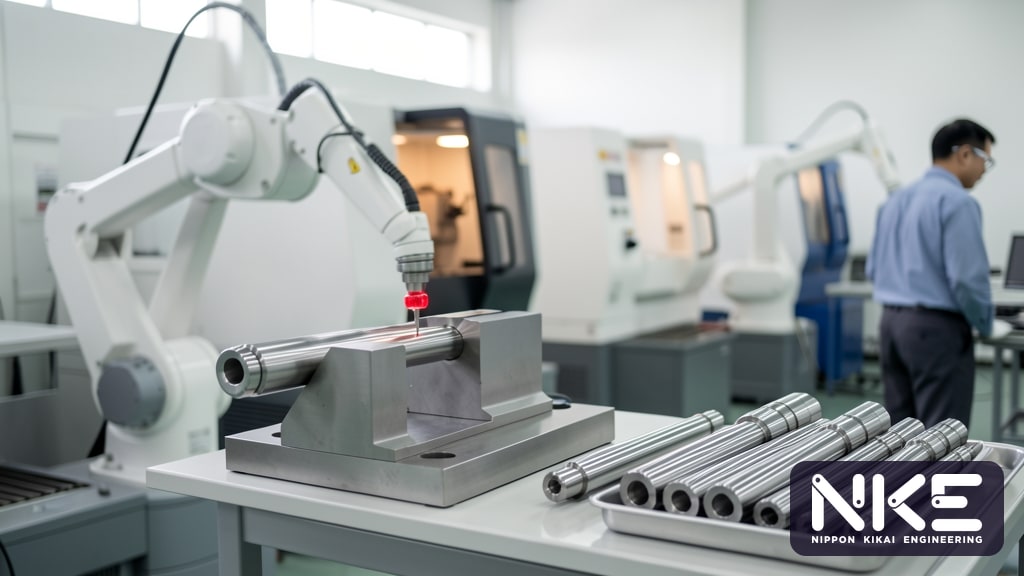
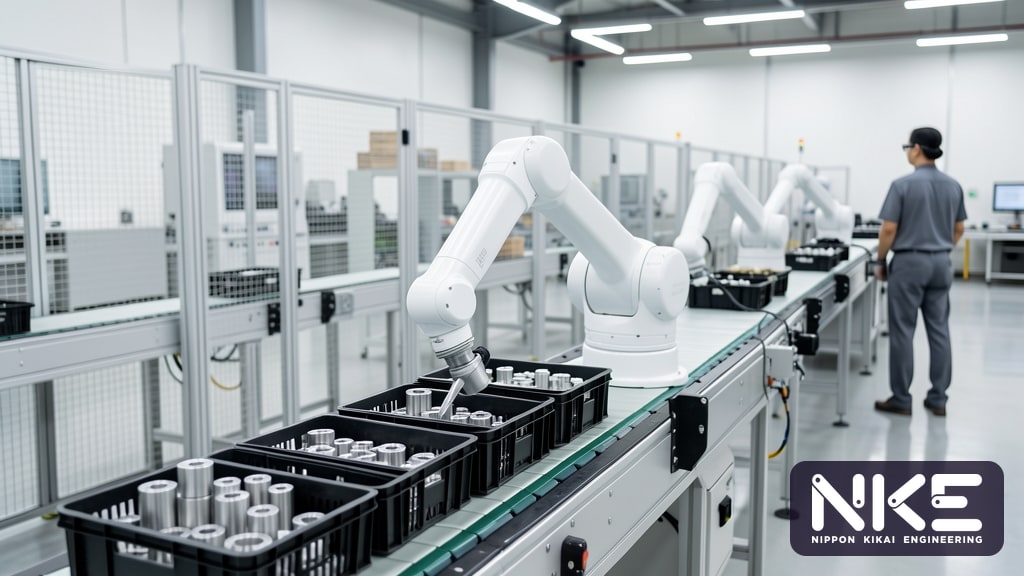
A pick and place robot takes a part from a source, such as a conveyor, tray or bin, and puts it at a destination, such as a package, an assembly fixture or another conveyor. A typical cycle has four steps:
- Locate the part from a fixed position, a sensor or a vision camera.
- Move and pick using a gripper such as a vacuum cup, pneumatic fingers or a magnet.
- Transfer the part to the place position while keeping the required orientation.
- Place and release, then return for the next cycle.
Overall speed therefore depends not only on the robot, but also on travel distance, gripper grip and release time, and how parts are presented to the robot.
Robot types used for picking
Each robot structure suits a different job. For a broader overview, see types of industrial robots.
SCARA
SCARA robots move quickly in the horizontal plane and are stiff vertically. They suit small to medium parts handled on a single plane, such as moving components from a conveyor into trays or loading parts into an assembly fixture. The trade-off is limited tilting of the part and a working area confined to a circle around the base.
Delta (parallel link)
Delta robots hang from above and use several lightweight linked arms, so they can accelerate and stop very quickly. They are common for picking light items from fast conveyors in food, pharmaceutical and electronics lines, but payload is low and the working envelope is a dome beneath the robot.
Six-axis articulated robots
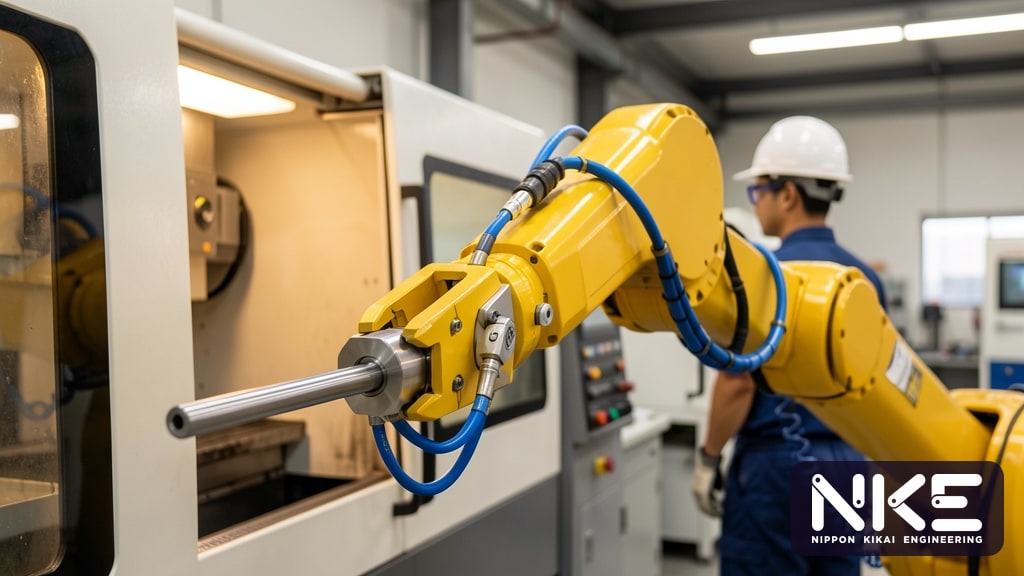
Six-axis robots offer the most flexibility. They can rotate and flip parts, reach into machines or boxes, and come in sizes from small to very high payload. They are a good fit when the part must change orientation or one cell has to handle several tasks, although for short pick and place moves they are usually slower per cycle than SCARA or delta robots.
Collaborative robots
Cobots suit tasks close to operators, lines that change products often, or tight spaces. Their speed is generally limited for safety, so they are rarely the answer for very high rates. Read more in what is a cobot.
What to check before choosing a robot
- Total payload: add the gripper weight to the part weight, and check how far the centre of gravity sits from the flange.
- Required cycle time: start from line output. As a hypothetical example, a line needing 30 parts per minute leaves roughly two seconds per pick and place cycle, including grip and release. If one robot cannot keep up, consider a multi-pick gripper or a second robot.
- Reach and layout: pick and place points should sit comfortably inside the work envelope, not at the very edge of reach.
- Placement precision: inserting parts into fixtures or pins needs tighter repeatability than dropping them into a carton.
- Part characteristics: oily, porous, fragile, soft or perforated parts directly affect gripper choice. See how to choose a robot gripper.
- Environment: dust, coolant, humidity or wash-down requirements may call for a robot with higher ingress protection.
Part presentation: fixed position, conveyor tracking or vision
Many projects stall not because of the robot, but because nobody planned how parts would arrive at it.
Fixed position
Parts sit in trays or chutes with known positions. This is the simplest and most reliable approach, but something upstream has to arrange the parts first.
Conveyor tracking
The robot follows parts on a moving belt using an encoder, so the conveyor never has to stop. It suits continuous lines, but belt speed must be matched to what the robot can actually handle.
Vision
A 2D camera finds the position and angle of parts lying flat, while 3D vision handles stacked parts or varying heights. Vision adds flexibility, but lighting, background and calibration need to be well controlled.
Common mistakes in pick and place projects
- Relying on catalogue top speed when real cycle time depends on the path, gripper weight and vacuum build-up time.
- Skipping trials with real parts, especially oily, uneven or multi-variant parts.
- Ignoring changeovers: with several models, plan quick-change grippers, adjustable trays and per-model programs from the start.
- Overlooking upstream and downstream work: if someone still has to feed empty trays and remove full ones all shift, the gain may be small.
- Incomplete safety design: guarding, sensors and safe access for refilling and clearing jams.
If the end of the line stacks cartons or bags onto pallets, plan the picking cell together with a robot palletizing system so material keeps flowing smoothly.
FAQ
SCARA or six-axis: which is better for pick and place?
If parts stay on one plane, do not need flipping and speed matters, a SCARA is usually the better fit. If parts must be reoriented, the robot has to reach into a machine, or one robot will handle several tasks, a six-axis robot is more flexible.
Does every pick and place application need vision?
No. If trays or chutes can hold parts in known positions, the system is simpler and easier to maintain. Vision makes sense when parts arrive randomly or when many variants are hard to pre-arrange.
What information should I prepare before talking to a system integrator?
Prepare drawings or sample parts, weights, the number of variants, target output, how parts enter and leave the station, the available floor space and a video of the current operation. This helps the integrator assess options quickly and accurately.
If your plant wants to take repetitive picking work off its operators, NKE's engineers, as a FANUC Global Partner, can review your parts, select the robot and gripper, and design a cell that fits your actual line. Explore our factory automation solutions or contact NKE on 02-746-7196 or LINE @nke.th.