EV Auto Parts in Thailand: Precision Machining with Automation
Many Thai automotive suppliers are already quoting EV auto parts, or expect to soon. That raises practical questions: will existing machines and methods still work, how much tighter are the tolerances, and how do you hold consistent quality on every shift when skilled setters and operators are getting harder to hire? This article covers what changes, where the risks are, and which kinds of automation make this work easier to win and keep.
How EV auto parts differ from engine parts
An electric vehicle has no combustion engine and usually no multi-speed gearbox, so the list of machined parts changes noticeably.
Parts that become less important
- Engine parts such as crankshafts, camshafts, connecting rods and fuel injection components
- Exhaust and fuel system parts
- Gears and shafts for multi-speed transmissions
Parts that become more important
- Rotor shafts and shafts for the reduction gear unit
- Motor and drive unit housings, often cast aluminium with thin walls and several bearing bores
- Thermal management parts such as coolant fittings and pipes for the battery and motor
- Battery structures and mounting parts
The processes are still turning, milling, drilling and grinding. What changes is the precision customers expect and how consistently it must be held across high volumes.
Tighter precision requirements in EV work
Electric motors run at higher speeds than typical engines, and EV cabins are quieter, so gear whine or shaft imbalance is far easier to hear. NVH (noise, vibration, harshness) therefore drives the tolerances on many parts.
- Concentricity and runout on shafts: bearing seats and splines must be accurately related to each other.
- Bearing bore size in aluminium housings: aluminium expands more with temperature than steel, so part temperature at the time of measurement matters.
- Thin walls and clamping: too much clamping force distorts the part, so it measures good on the machine but changes once unclamped.
- Cleanliness and burrs: chips or burrs left inside a motor assembly can cause electrical and wear problems.
As a result, periodic spot checks are often not enough. Many manufacturers now measure more often, watch size trends, and adjust the machine before parts drift out of tolerance.
Why the labour shortage makes this harder
This level of precision has traditionally relied on experienced people: setters who know when to compensate for tool wear, and operators who read CMM reports and enter the right correction at the machine. With fewer of these people available, common problems appear:
- Quality varies between shifts because each person makes different decisions.
- Machines sit idle waiting for someone to measure or adjust, stretching the real cycle time.
- Manual offset entry invites typos, wrong tool numbers or wrong signs.
- Night shifts are hard to staff, so machines don't run their full available hours.
Automation is not only about reducing headcount. It turns the know-how of your best people into a repeatable process that runs the same way on every shift.
Automation that helps make EV parts accurately and consistently
Robotic machine tending
A robot loads and unloads CNC machines with the same position and timing every cycle, reducing the risk of mis-seated parts and letting machines run continuously with fewer people on the floor. If you are considering this, see how to evaluate whether machine tending is worth the investment.
Feeding measurement results back to the machine
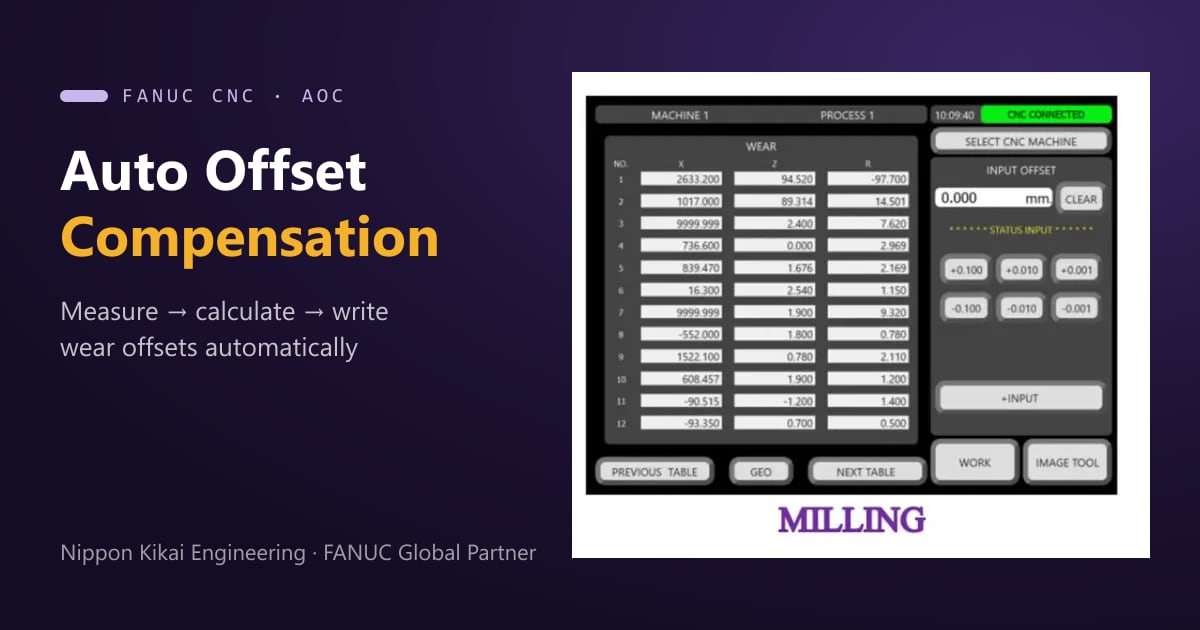
Instead of someone reading the CMM result and walking over to type in a correction, an auto offset system takes the measurement data and writes tool wear offsets to FANUC CNC machines automatically, based on rules you define. NKE AOC is a centralized system that does exactly this, reducing manual entry errors and keeping a record of every adjustment for traceability. Learn more about Auto Offset for FANUC CNC.
Dedicated machines for shaft parts
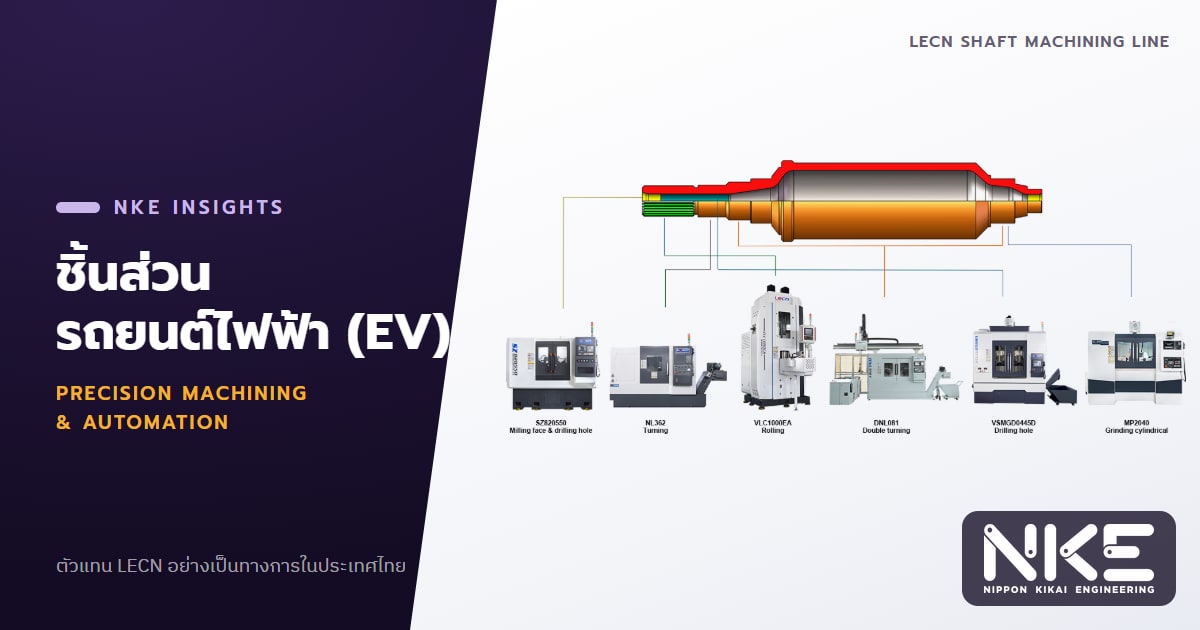
Rotor shafts and reduction gear shafts are high-volume parts with similar geometry. Machines designed specifically for shafts, for example processing both ends in a single clamping, cut down on re-clamping, which is a major source of concentricity error. NKE is the official authorized agent in Thailand for LECN machines, special-purpose machines built for shaft parts.
Machine data systems
When fewer people are watching the machines, you need to know why and for how long they stop. Machine monitoring and OEE tracking show whether losses come from waiting for measurement, tool changes or part loading, so improvements go where they matter.
Where to start, and common mistakes
- Pick a pilot part with steady volume and a clear quality problem or bottleneck.
- Record the current state: cycle time, time spent waiting for measurement, scrap rate and reasons for stoppages.
- Review the process before automating it: fixtures, cutting sequence and measurement points.
- Design the cell for changeovers, because EV volumes and models can shift with the market.
- Plan training so your team can run the system and handle basic troubleshooting themselves.
Common mistakes:
- Adding a robot without fixing the clamping problem, so the automation simply produces scrap faster.
- Measuring aluminium parts straight after machining without allowing for part temperature.
- Building a cell locked to one part, so a model change means starting almost from scratch.
- Ignoring chip and burr management, which affects both quality and robot reliability.
FAQ
Can CNC machines used for engine parts be used for EV parts?
Often yes, but check machine accuracy, the ability to clamp thin-walled parts without distortion, and your measurement capability first. Some jobs will need new fixtures, more frequent measurement, or a dedicated machine alongside.
Should we start with robotic tending or automatic offset compensation?
It depends on your main problem. If the bottleneck is not having enough people to load parts, start with machine tending. If sizes drift and time is lost waiting to measure and adjust, auto offset may deliver a clearer benefit. Many plants end up using both.
Can a mid-sized plant afford automation for EV work?
Yes, if you start with a well-defined pilot line, evaluate it against your own production data, and design it so it can be expanded later rather than automating the whole plant at once.
If your plant is preparing for EV auto parts, or you want to rely less on scarce skilled labour for high-precision work, NKE's engineers can help review your process and design a solution around your parts. Contact NKE, call 02-746-7196, or reach us on LINE @nke.th.